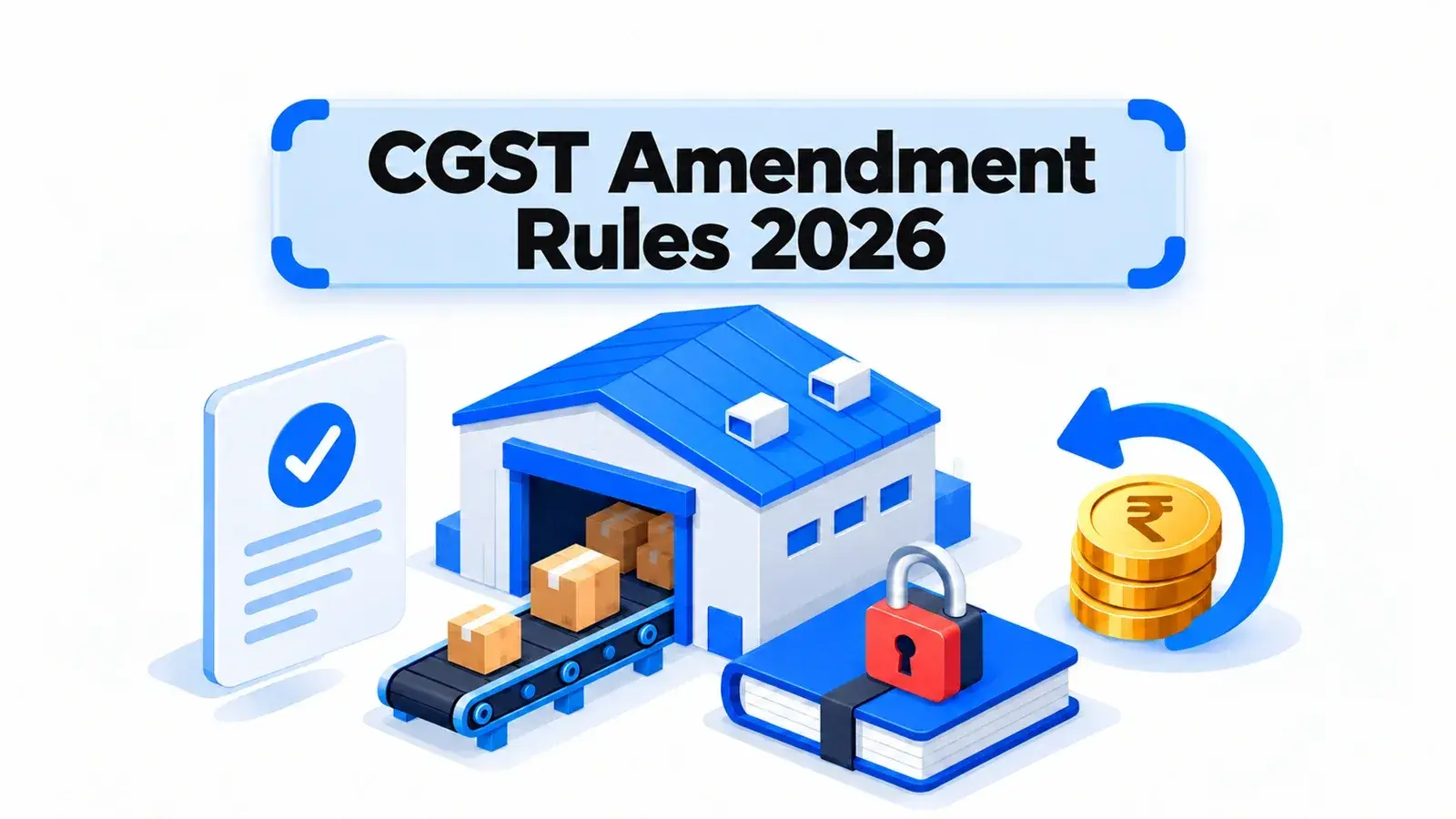
On 26 October 2026 the Central Board of Indirect Taxes and Customs (CBIC) notified the Central Goods and Services Tax (Amendment) Rules, 2026 through Notification No. 05/2026–Central Tax. The changes touch GST registration, cancellation, input tax credit (ITC) and refunds, and they roll out in phases from 1 November 2026.
This guide explains the changes that matter most to startups, e-commerce sellers and growing businesses, and what to do before each date. We read the notification text itself for the registration and cancellation rules. For the refund and later-phase rules we relied on published analyses, which are listed under Sources.
Quick summary
- The rules start on 1 November 2026, with further phases on 1 December 2026, 1 January 2027 and 1 April 2027.
- New Rule 14B lets some small sellers register in another state by using an e-commerce operator's warehouse as their principal place of business.
- Cancellation on request now needs your returns filed first and stock details declared, and the registration is suspended while the application is pending.
- From 1 April 2027, the portal can suspend registrations for specified defaults, and a new route to revoke cancellation arrives.
- Refunds get faster acknowledgement (10 days) and risk-based provisional refunds, with a revised formula for inverted duty claims.
Timeline at a glance
- 1 November 2026: General commencement. This includes new Rule 14B, the substituted Rule 19 on amending registration, and the substituted Rule 20 on cancellation on request. Refund changes in Rules 89 to 91 are reported to start on this date too.
- 1 December 2026: Rule 19(3) and the revised forms, including REG-16 and RFD-01, according to published analyses.
- 1 January 2027: Changes to GSTR-7A and the e-invoice schema (INV-01), according to published analyses.
- 1 April 2027: Rules 21A (suspension), 22 (cancellation by the officer), 23A (revocation), the revised Rule 86A and the capital-goods refund provisions.
Secondary sources differ slightly on the dates for individual forms. For the form you actually use, check the notification text.
Registration
Rule 14B: registering through an e-commerce operator's warehouse
Today, a seller who stores goods in a warehouse in another state generally needs a separate registration there. Rule 14B creates a simpler option for some sellers. A person registered in a "home" state can get registration on the same PAN in another state where they have no physical presence, by declaring an e-commerce operator's (ECO) warehouse as the principal place of business.
The conditions in the notification are:
- You supply goods through an ECO that must collect tax at source under section 52.
- Your total output tax liability on such supplies to registered persons (other than persons on the same PAN) does not exceed ₹2.5 lakh per month.
- The ECO consents to you declaring its warehouse as your place of business. The ECO may consent within seven working days, otherwise the application is not processed further.
- You apply in FORM GST REG-01, with Aadhaar biometric authentication and document verification, followed by physical verification of your premises in the home state.
- If the officer does not complete physical verification within 30 days after authentication and document verification, the application is deemed approved.
- If the physical check finds you do not conduct any business in the home state, the application is treated as rejected.
Things to know before choosing this route:
- A person who has not opted for Aadhaar authentication is not eligible.
- You cannot hold another registration in the same state on the same PAN.
- The registration is cancelled electronically (REG-38) in specified cases, such as the ECO withdrawing permission and you not amending your details within 30 days, or your home-state registration being cancelled.
- You must keep your books of accounts and records at your principal place of business in the home state.
Changes to existing registrations (Rule 19)
The substituted Rule 19 says you must report a change in registration particulars within 15 days by filing FORM GST REG-14. If the officer does not act within the time allowed, the certificate is deemed amended. A few points worth noting:
- A change in the legal name, or in partners, directors, Karta, trustees, managing committee or CEO (or equivalent), applies to all registrations on the same PAN in every state.
- A change of the authorised signatory's mobile number or email needs online verification.
- If a change in constitution changes the PAN, the person must apply for a fresh registration.
Cancellation on request (Rule 20)
The new Rule 20 applies from 1 November 2026. If you want to cancel your registration:
- Apply in FORM GST REG-16 within 30 days of the event that makes cancellation necessary (the time limit does not apply on the death of a sole proprietor).
- Declare the inputs held in stock, inputs in semi-finished and finished goods, and capital goods in stock, along with the related liability and any payment made.
- File all returns due up to the date of application first. If you filed GSTR-1 or used the Invoice Furnishing Facility for a tax period, you must also file the GSTR-3B for it.
- Once you submit the application, the registration is suspended until the cancellation proceedings are complete.
Where returns are filed and dues are paid, the portal can cancel the registration electronically in specified cases. One of them is where the output tax liability on supplies to registered persons never exceeded ₹2.5 lakh in any month from registration to the date of application. Other cases go to the officer for examination.
From 1 April 2027: suspension, revocation and ITC blocking
These provisions start later. We rely on TaxGuru's and India Briefing's analyses here, so confirm exact wording in the notification before acting.
Suspension by the portal (Rule 21A)
The portal can suspend a registration electronically for specified defaults, such as:
- A composition taxpayer's annual return pending beyond three months.
- Monthly returns missed for six consecutive months, or quarterly returns missed for two consecutive periods.
- Not complying with Rule 10A on bank account details.
You receive a notice in FORM GST REG-31, generally with 30 days to comply. While suspended, you cannot make taxable supplies or issue GST invoices. The suspension is revoked once you comply.
Cancellation by the officer and revocation (Rules 22 and 23A)
If a suspension is not fixed within 30 days, the portal can cancel the registration. Under the new Rule 23A you can apply in FORM GST REG-21 within 180 days of cancellation after curing the default. Returns that fell due between cancellation and revocation must be filed within 30 days of the revocation order.
Blocking ITC (Rule 86A)
Officers can restrict use of the electronic credit ledger where they consider the credit fraudulent or ineligible. The new process works through FORM GST DRC-26. You can object in DRC-27, get a hearing and receive an order in DRC-28. A restriction lasts up to one year unless lifted earlier.
Refunds
- Acknowledgement (Rule 90): The period to acknowledge a refund application, or to issue a deficiency memo, falls from 15 days to 10 days. If nothing is issued, the application is deemed acknowledged.
- Provisional refund (Rule 91): The portal can run a risk evaluation and generate the provisional refund order (FORM GST RFD-04) within three working days of acknowledgement, without waiting for the officer.
- Zero-rated supplies (Rule 89): The 1.5-times domestic supply cap in Rule 89(4)(C) is removed from 1 November 2026, according to TaxGuru's analysis.
- Inverted duty refunds: The maximum refund is the turnover of inverted-rated supplies multiplied by Net ITC and divided by adjusted total turnover, minus the tax payable on those inverted-rated supplies. Net ITC now includes eligible input services from 1 November 2026, and ITC on capital goods from 1 April 2027, spread over 60 months. Claims need a declaration that the capital goods have not been sold or disposed of.
- Form RFD-01: A revised form applies from 1 December 2026.
A different thing: the 57th GST Council recommendations
Do not mix this notification up with the outcomes of the 57th GST Council meeting held on 8 October 2026. Press coverage reports that the Council made no rate changes and recommended measures such as removing arrest powers, raising the prosecution threshold from ₹1 crore to ₹5 crore, cutting the general penalty from ₹25,000 to ₹10,000, and giving conditional late-fee relief to small taxpayers. These are recommendations. They need separate notification, and most are reported to be planned from 1 April 2027.
Also note that a different notification with a similar number, 05/2026–Central Tax (Rate) dated 27 October 2026, deals with the nominated agency definition and is unrelated to the rules discussed here.
Checklist by type of business
- E-commerce sellers: Check whether you meet the Rule 14B conditions, get your ECO's consent process in order and enable Aadhaar authentication on your registration.
- Businesses with several registrations on one PAN: Plan name and partner changes carefully, because they now apply to all registrations together.
- Businesses closing down or restructuring: Reconcile stock and file all returns before you apply for cancellation, and expect suspension from the day you apply.
- Every registered business: File returns on time and keep your Rule 10A bank details updated. From 1 April 2027 prolonged defaults can lead to automatic suspension.
- Exporters and inverted-duty claimants: Keep records of capital goods and input services, because both now feed into refund calculations.
- Composition taxpayers: Track the annual return date, since delay beyond three months is a suspension ground.
Frequently asked questions
Does the ₹2.5 lakh limit in Rule 14B apply to my total turnover?
No. As worded in the notification, it is the output tax liability on your supplies through the ECO to registered persons, other than persons on the same PAN, in a month. It is not a turnover limit.
Do these rules change the GST registration turnover limit?
Nothing we reviewed in this notification changes the turnover thresholds for registration.
When will the 57th Council's penalty and arrest changes start?
They are recommendations and need notification. Coverage we reviewed reports most as planned from 1 April 2027. Check CBIC notifications for the final position.
Will my registration be suspended automatically?
From 1 April 2027, the portal can suspend a registration for specified return and compliance defaults, after sending a notice with generally 30 days to respond.
Which provisions should I act on first?
Those effective 1 November 2026: Rule 14B if you sell through ECOs, the new Rule 19 timelines for changes in registration details, and the new cancellation process in Rule 20.
This article is general information and not tax advice. GST rules and forms change often, so confirm the position for your own registration with a tax professional.
Not sure how these changes affect your GST registration or refund claims? Talk to the StartupKaro team about your set-up.
Sources
- Notification No. 05/2026–Central Tax dated 26 October 2026 (published copy of the CBIC notification)
- TaxGuru: CGST Amendment Rules 2026, analysis of 67 amendments
- India Briefing: India's CGST Amendment Rules 2026, registration, cancellation, ITC and refunds
- Careerindia: 57th GST Council recommendations 2026
- Set India Biz: GST Council reforms 2026
Found this useful?